01Organizational bottlenecks.
Ask any head of talent acquisition whether their team and their hiring managers get along, and most will say yes. They are not lying. They are answering a different question than the one that matters.
A 2026 alignment survey by Metaview, fielding 505 recruiting leaders and hiring managers across North America and EMEA, found that 90% of respondents rate the partnership between TA and hiring managers as "good or excellent." The same survey, deeper in, found that 58% of those same respondents privately wish they could work around their counterpart.
The two numbers are not contradictions. They are the diagnostic. Professional cordiality is what teams give each other when they cannot fix the thing they actually need to fix.
Source: 2026 alignment survey of 505 recruiting leaders and hiring managers across NA and EMEA.
Professional courtesy is what teams give each other when they cannot fix the thing they actually need to fix.
02Two-thirds of teams lose candidates monthly.
The leading indicator that the cordiality is costing real money is candidates lost to faster competitors. The same survey reports that 67% of hiring teams lose qualified candidates this way every month. Teams with below-excellent partnerships lose them 60% more often — an 80% monthly loss rate versus 50% for excellent partnerships.
The cost compounds quickly through any plausible model of a recruiting desk.
A 50-meeting-per-quarter recruiting desk handles 200 candidate meetings a year. At the 39.6 meetings-per-placement ratio documented in Trusting the AI (Briefing 08), that is roughly five placements annually. The data shows that teams with below-excellent partnerships report monthly candidate loss 60% more often than excellent ones — 80% versus 50%. On any reasonable model of how often that translates into a lost qualified meeting, the differential between the two partnership states is 0.3–0.5 placements per year per desk. At ¥107,676 expected revenue per qualified meeting (same source), the foregone revenue runs into the millions per year. The math is illustrative, not a platform output. The directionality is what matters: cordiality is operationally cheap. Cordiality without alignment is operationally expensive.
Candidates do not leave because they were unloved. They leave because someone else moved first.
03Both sides are right. That is the diagnostic.
The survey's open-response data is more revealing than any of its headline percentages. Hiring managers and recruiting leaders, asked what they wished their counterpart understood, do not complain about each other personally. They complain about evidence and speed.
From the open-response section of the same survey:
Hiring managers say:
"Quality over quantity — stop wasting my time with bad matches."
"Move faster, I'm losing candidates to competitors."
Recruiting leaders say:
"Trust my expertise — I do this for a living."
"Give me feedback faster — your delays cost us candidates."
Read them next to each other. The hiring manager wants better-evidenced candidates, faster. The recruiting leader wants their judgement trusted and their feedback loop closed. Both grievances are about the evidence layer between them — not about each other. (The survey labels these roles "Recruiting leaders" rather than "TA"; we use the latter elsewhere in this briefing.)
Both sides are right. That is the diagnostic.
04The same fault line, viewed from Japan.
The alignment gap is measured in the US and EMEA. The Japan corporate hiring market has a different surface symptom but the same underlying fault — and we have 25 months of data on it.
In The Decision Gap (Briefing 03) we documented a structural shift across ExecutiveSearch.AI K.K.'s corporate clients: the 2nd-to-Final advance rate has dropped from 49% to 33%. The close rate on the other side has gone up by 18 points, from 40% to 58%. Same starting volume, 31% fewer hires. The funnel leaks at the commitment stage.
| The fault line | External survey · NA + EMEA | ExecutiveSearch.AI · 25-month Japan funnel |
|---|---|---|
| What gets measured | Partnership rating, candidate loss rate | Stage-by-stage advance rate |
| Where the symptom appears | 67% of teams lose candidates monthly | 2nd → Final drops 49% to 33% |
| What broke underneath | The evidence layer between HM and TA | The evidence layer between HM and committee |
| What closes the gap | A shared evidence layer installed upstream of the commitment. | |
Two markets, two symptoms, one structural answer. The cheapest place to install shared evidence is the JD itself, before the search begins.
The 2026 alignment data measures the gap in the US and EMEA. Our Japan funnel data shows the same fault line at the commitment stage.
05The right kind of AI. The wrong kind.
The survey's sharpest finding is not that AI helps hiring teams. It is which kind of AI helps which kind of hiring team. The data separates two architectures cleanly.
Teams that treat AI as a shared system — one source of evidence both sides work from — are 3.8× more likely to rate their HM–TA partnership "excellent." They start 68% of their searches with high alignment, versus 49% for teams without AI — a 40% lift on the leading indicator. Teams that treat AI as a stack of individual copilots running in parallel see no such effect.
-
Wrong shape · Individual copilots, in parallel.
A productivity tool for the recruiter. A different productivity tool for the hiring manager. Bottom-up tool adoption. The two sides move faster on their respective tasks — and farther apart on the things they need to agree about.
-
Right shape · A shared system, one source of evidence.
One ranked candidate list. One scoring rubric. One fit summary. The HM and TA do not need to argue about which candidates to look at first — they are already looking at the same list, with the same evidence, in the same order.
Two tools that each make one person faster do not add up to a team that moves together.
06Alignment before the JD goes out.
Most AI sourcing tools begin working after the JD is finalized and the search has started. Headhunt.AI returns a ranked candidate list against the 4M+ Japan-focused profile universe in 1–2 minutes — which means the hiring manager and the TA can see what the market actually contains before the JD is locked.
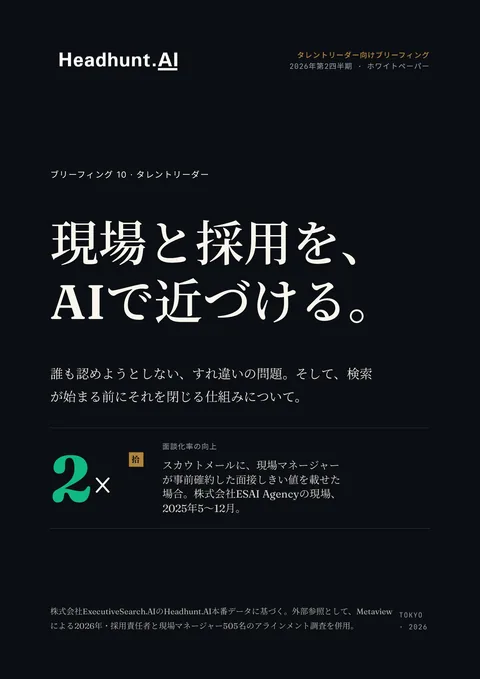
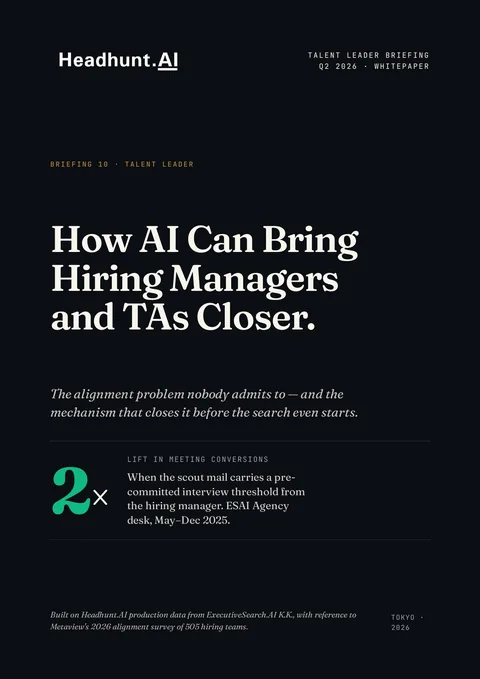
Two of the three mechanisms below are about calibration. The third is about commitment — and produces the 2× lift the cover carries.
-
Mechanism 01 · Calibration. Refine the JD against actual market supply.
A hiring manager writes a JD with a tight spec — years-of-experience band, language requirement, salary range. The TA suspects the candidate that spec describes does not exist in volume. They run the draft JD through Headhunt.AI before publishing. Both sides look at the ranked list the spec actually returns. The conversation that used to happen in week three of a stalled search — "the brief was too narrow" — happens in five minutes at intake.
-
Mechanism 02 · Pressure-test. Test language and salary before commitment.
The same query exposes a second friction. A hiring manager writes N1 bilingual into the JD because the previous person had it. The platform shows where the viable candidates actually cluster on the inferred Japanese language signal and where N1-eligible candidates sit on current comp. The TA no longer has to argue. The data does. The JD goes out with revised language requirements, or a revised salary band, or both — once, deliberately, before two months of misaligned sourcing.
The cheapest place to fix a misaligned search is the JD that hasn't gone out yet.
07Pre-commit thresholds. The 2× mechanism.
The third mechanism is the one most aligned with the survey's "shared system" finding — and the only one with a hard production number attached. It is also the one most resistant to being misread as a productivity feature: it is a commitment device, not a workflow tool.
Mechanism 03 · Commitment. Pre-committed interview thresholds in the scout mail.
Before the search starts, the hiring manager looks at the top 20 candidates the platform returns against the draft JD and commits to a threshold: any candidate scoring above 70 on the ESAI Score for this role, I will personally interview within five business days of a positive reply. The Headhunt.AI scout mail surfaces that commitment in the message itself. The mechanism has a Japanese name on our own desk: 面談確約スカウト — the "interview-guaranteed scout."
Source: ESAI Agency production data. A/B comparison of scout-mail variants — pre-committed interview threshold versus standard outreach. Methodology appendix in the PDF.
Reply rates can be moved by copy. Meeting conversions are moved by what you have actually committed to.
08What shared evidence looks like during the search.
The alignment built in Section 06 has to survive contact with the actual search. Three components carry it forward — each one a piece of evidence the hiring manager and the TA work from together, not a productivity tool either side runs in isolation.
-
Screening Guidance.
At intake, the hiring manager writes once — in free-form natural language — the nuances that do not fit a JD. The things they would tell a TA in a sidebar conversation if they had the time. The AI factors that context into ranking and into the fit summary it produces for every candidate. The Screening Guidance is the codification of the pre-search alignment, carried into every downstream decision.
-
The ESAI Score (0–100) with written evidence.
Every candidate carries a numeric score and the reasoning behind it: which dimensions the candidate scores high on, which they don't, what the platform inferred from the profile and why. The TA does not pitch the candidate to the hiring manager — the evidence does. And because the score threshold was pre-committed in Mechanism 03, the hiring manager has already agreed to interview anything above the line.
-
The bilingual fit summary.
Structured, written so the hiring manager can read it without re-reading the resume. Japanese or English, depending on who reads it. The same summary works in the in-house operating model (where the hiring manager sits two desks over) and the agency-mode workflow (where the "hiring manager" is the client company contact). Same shape of evidence, different audiences.
The fastest conversation between a hiring manager and a TA is the one they do not need to have.
09Production data, our own desk.
We use Headhunt.AI on the ESAI Agency desk every day. The Q1 2026 production lift on the same recruiters, comparing Headhunt.AI runs to their prior quarters on manual sourcing, is the strongest measurement of the architecture in everyday use.
Q1 2026 · ESAI Agency · Same recruiters · Per-recruiter lift. Same recruiters. Same market. Same fees. Better evidence layer.
The lift at any single stage is modest — 13–14%. Stacked, it compounds. Layered on top: a 17.2× return on credits over 16 weeks of ESAI Agency runs (documented in Trusting the AI, Briefing 08), and a +78% daily-reply lift across a 526-day production log (Briefing 09). The newest layer is the 2× lift in meeting conversions from the pre-committed interview-threshold mechanism — the 面談確約スカウト — that anchors Section 06.
These numbers come from an agency desk. The agency's "hiring manager" is the client company. The alignment architecture is identical to in-house deployment, and the lift would plausibly compound the same way for in-house TAs against in-house dynamics — for the same structural reasons.
Same recruiters. Same market. Better evidence. Better partnership.
10Three models. One architecture.
Each of the three has the same engine underneath. The difference is who runs it, and who carries the pre-search alignment forward.
-
Model 01 · Headhunt.AI License. Your in-house TA team runs the platform.
Your TA team logs in, pastes the JD, and gets a ranked shortlist from the 4M+ profile Japan database in 1–2 minutes. Your hiring managers participate at the JD-calibration step and the pre-commit threshold step. The shared system sits on your desk. Credit-based pricing. Credits never expire.
-
Model 02 · AgentRPO. Our recruiters run it on your roles.
Same architecture, run as a managed service. Your hiring manager participates in the JD-calibration step at kickoff and reviews the pre-commit thresholds before the scout mails go out. The alignment work is done jointly; the search execution is ours.
-
Model 03 · Single-role pilot. One role. 20 AI-scored candidates. 48 hours. No card.
The pilot is itself the alignment test. Your hiring manager reviews the 20 against their gut, sees whether the evidence matches their judgement, and learns whether the gap closes before any search dollars are committed.
The test is not "is the AI smart." It is "do the hiring manager and the TA end the meeting on the same page."
11Seven questions worth asking inside your org.
A diagnostic checklist. Each question targets one symptom of the alignment gap. Answer them honestly. The number of specifics you can produce is the diagnostic.
-
Do you measure the rate at which hiring managers send candidates back to TA within 24 hours of a longlist delivery — or only the eventual hire rate?
-
When a hiring manager rejects a longlist candidate, does the rejection produce a documented reason TA can use, or a soft signal?
-
Before the JD goes to public boards or agency partners, has your hiring manager seen the top 20 candidates the market would actually return against it? If not, the JD is a bet on a market the hiring manager has not seen.
-
For your last five searches, did the hiring manager commit upfront to an interview threshold — a score, a profile band, anything specific — that TA could use to qualify candidates without going back for approval? If the answer is "they reviewed each longlist," the friction is built into your process.
-
What fraction of your kickoff meetings end with the hiring manager and TA having written down the same fit criteria, in the same words? The survey says 49% for non-AI teams. What is yours?
-
If a candidate replied "yes" to a scout mail tomorrow on a role still in intake, do you have a place to put them so they do not go cold? The 67% monthly candidate-loss number lives here.
-
Of your last five hires, how many would the hiring manager have advanced if they had read TA's first-look summary blind, without the verbal pitch?
6–7 specifics: Alignment is instrumented well enough that the gap is visible and addressable. The fastest stress test is the single-role pilot.
4–5 specifics: Visibility but not mechanism. The cheapest first install is the pre-commit threshold.
2–3 specifics: The data layer is light. The gap is likely affecting you, just below the surface.
0–1 specifics: Operating without instrumentation. The most expensive position to be in, regardless of headcount.
12What we expect to be asked.
The questions that come up most often when we walk through this material with peer agency principals, heads of talent acquisition, and hiring leaders. Honest answers.
"What is the hiring-manager / TA alignment gap?"
A 2026 alignment survey of 505 recruiting leaders and hiring managers across North America and EMEA found that 90% rate their partnership "good or excellent" on the surface, while 58% privately wish they could work around their counterpart, and 67% lose qualified candidates to faster competitors monthly. The two numbers are not contradictions: the surface cordiality is what teams give each other when they cannot fix the evidence layer between them.
"What's the 2× mechanism that doubled meeting conversions?"
Before the search starts, the hiring manager looks at the top 20 candidates the platform returns against the draft JD and commits to a threshold — for example, any candidate scoring above 70 on the ESAI Score, the hiring manager personally interviews within five business days of a positive reply. The Headhunt.AI scout mail surfaces that commitment in the message itself. On the ESAI Agency desk between May and December 2025, across 5,000 candidates, the variant carrying the pre-committed threshold doubled meeting conversions against the standard outreach variant.
"Is this measured on the same data as the +78% reply lift?"
No. The +78% daily reply figure comes from the 526-day production log documented in Briefing 09 (Production Evidence). The 2× lift here is a separate measurement: a scout-mail A/B test running May through December 2025, 5,000 candidates, comparing two scout-mail variants against each other. Reply rates can be moved by copy; meeting conversions are moved by what was actually committed to.
"Does this work for in-house TA teams, or only agency recruiters?"
The mechanism is structurally identical. On an agency desk the "hiring manager" is the client company contact; on an in-house deployment the hiring manager sits two desks over. The alignment architecture — calibrate the JD against actual market supply, pressure-test language and salary before commitment, surface a pre-committed interview threshold in the scout mail — works the same way in both. The published 2× lift is from the agency desk; the structural reasons that produced it carry across to in-house teams.
"What does this mean for the JD writing process?"
The argument is to do the alignment work before the JD is finalized rather than after. Headhunt.AI returns a ranked candidate list against 4M+ Japan-focused profiles in 1–2 minutes, so the hiring manager and the TA can see what the market actually contains against a draft spec before publishing. The conversation that used to happen in week three of a stalled search — "the brief was too narrow" — happens in five minutes at intake.
"Where can I read the full methodology?"
The 16-page A4 PDF includes the full methodology appendix: the Metaview 2026 alignment survey (N=505, 200+ employee companies, NA + EMEA, 19-question instrument via Cint), the ESAI Agency 5,000-candidate A/B test (May–December 2025, 8 months), the ESAI Agency 16-week production cohort (123,675 candidates contacted, 3,868 replies, 1,260 meetings booked), and the ExecutiveSearch.AI 25-month corporate funnel (Mann-Kendall non-parametric test on rolling 6-month conversion: z = −2.42, p = 0.015).
The right way to decide is not to argue about it. It is to test it on one of your own roles.
13The honest take.
The alignment gap between hiring managers and TAs is real, measurable, and expensive. It is also fixable — and the fix runs upstream of the search, on the JD itself, with one shared system both sides work from.
The 2026 survey points at the architectural shape that closes the gap. Our own production data, on our own desk, points at the specific mechanism that drives the lift — a 2× improvement in meeting conversions when the scout mail carries a hiring-manager commitment instead of an open-ended ask. Same engine. Same architecture. The compounding gain is alignment-shaped.
The companies that install shared evidence at the JD step will compound their hires through the next cycle. The companies that keep running individual copilots in parallel will run the same headcount strategy with materially fewer placements per quarter, and absorb the cost of the difference.
These systems are the worst they will ever be today. The pace of improvement in AI is not linear — invest now to stay ahead of your competition, or fall behind.
This is uncomfortable to read. It is more uncomfortable to act on. Doing nothing is a decision, the same as any other. It just looks more like the present, which makes it feel safer than it is.